

Stage Tec AVATUS – More Desk? Or More Desks?
The capability of a sound desk is not only judged by how big or impressive an audio processing engine it has under the bonnet, but how quickly, smoothly and effectively it can complete the tasks in hand.
Already recognised for its speed of operation, the Stage Tec AVATUS has just doubled its power and value by adding full-fat dual-operator capability. Both operators can operate, set-up and manage their respective sound desks with access to all console functions, which crucially includes completely independent monitoring and selected-channel access.
Those facilities can be deployed on two completely independent mixes or programmes, or to distribute the workload for larger or more complex productions.
Two consoles for the price, hardware and space of one. So, with an AVATUS, you can start the day by asking “do I need More Desks? Or does today’s job need More Desk?”
(For speed, let’s call this MD2)
Your monitoring is here, or here, or here…
Uniquely, due to the highly adaptive and polished touchscreen interfac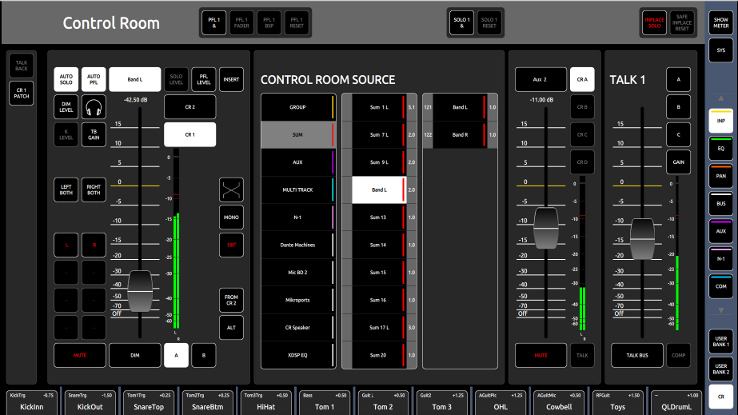 e of the AVATUS, providing two complete sets of console management, operation and monitoring does not require the doubling-up of console real estate to provide the full array of hardware buttons, displays, rotaries and panners for both operators. Monitoring control is a touchscreen entity that can be accessed at every desk segment with the monitoring selections and PFL/Solo operations addressing one of the two independent monitoring processors and buses, each with their own Talk paths and Talk key assignments.
While two operators at a console is nothing new, the significant benefit of the two-handed AVATUS is that it enables two sound supervisors to simultaneously undertake entirely separate tasks at the console:
- Mixing the on-stage act, while patching and pre-setting the console for the next.
- Fine-tuning the musical guest’s backing tracks while mixing the main chat-show programme output.
- Prepping and pre-mixing the highlights commentary while the live game is still to-air.
All quicker and simpler ways of getting the job done, not to mention the stack of small wins; not least removing the time wasted waiting for the other operator to complete their task at a single, hardware only, monitoring and selected-channel centre section.
But the MD2 two-handed capability is more subtle and flexible than the simple ability to divide the control surface bays between the two operators and the two mix tasks. It allows varying degrees of monitoring co-operation. For example, the same source selection made to both monitoring sections, but each with different monitoring levels, Mute and Dim settings or polarity swaps and talk key destinations.
This flexibility makes the AVATUS a prime choice for sound management in a TV Gallery. This requires the capabilities of a full-size desk for larger light entertainment programmes, but must also meet the sound requirements for a single operator managing sound and vision for the local news bulletin or opt-out magazine programme. The solution is to install the full-spec console in the sound “booth”, but a fader and single-touchscreen segment (The screen of which may be mounted on an articulated arm) in the main gallery, beside the vision switcher. The smaller panel works in partnership with the vision switcher allowing audio control of to-air sources on the Program Bus, while presetting the channel levels and settings for the Next-up source on the Preview Bus; with the sound desk doing the heavy lifting of fading between the two under control from the vision switcher.
An important factor with MD2 is that the control surface itself can be retained at its full size despite functioning as two separate desks, or the console can be specified with two or more physically independent sections which can be separated for the smaller individual tasks, but physically linked when the full console is required.
Sascha Kalifa, Stage Tec Managing Director, reported “The zones of the control surface and their assignment to a monitoring proce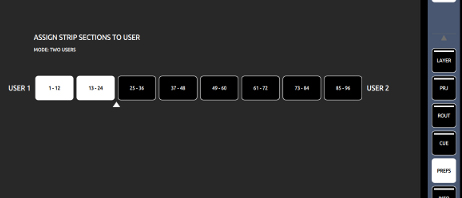 ssor can be configured on the fly or defined in the configuration selected at start-up. In addition to individual monitoring facilities, operators, within their own zones, can independently select fader-assignment layer – from a choice of 16; Auxiliary Sends, Clean-Feeds or Groups to faders and load mixer function or channel-to-fader assignment presets. But there is no restriction to which channels each operator can access. Every 12-fader console segment can directly access close to 200 channels; so 400 for two segments and so on.”
Sascha also commented that this latest firmware update improves the already impressive and highly regarded close-to-analogue tactile response of the console and now, for those comms-heavy productions, allows talk keys to be assigned to any of the available User Keys.
Practically better for those on the fly-pack.
Perhaps the most significant benefit of the new MD2 two-handed capability is that it represents significant cost savings for those servicing multi-sport events television production; equipping highly flexible and adaptable multi-functional studio or performance spaces or equipping a TV sound gallery that on occasion requires, in BBC parlance, a Grams Desk position.
For sports coverage, a full console can, for example, cover the opening and closing ceremonies, then physically and/or operationally be divided to provide two smaller mixers for coverage of individual sports or events.
As an example, two OB trucks with AVATUS consoles deployed at a multi-stage music festival, the consoles can be shared and divided to give two, three or four separate sound desks, each with varying size of console and mixing capacity. Complete freedom to assign console bays to any of the four sound desks according to the size and stature of the acts on up to four stages. A perfect and effective solution to the demands to deliver ever more live web or red-button streams.
For the practically minded, especially those equipping fly-pack or de-rig systems, that’s less hardware, fewer power supplies and less air conditioning – elements where Stage Tec systems already have a head-start; which means even less shipping, rigging, people and a consequently lower cost.


